The Road to Intelligent Process Automation - Gradient Flow
Extracto
An overview of process automation engagement trends in the Fortune 1000 and beyond. By Ben Lorica and Jenn Webb Most companies today have deployed automation technologies to streamline business processes—billing and accounting tasks, marketing and sales tasks, and other repetitive tasks that don’t require much (if any) human input. As businesses begin to experiment withContinue reading "The Road to Intelligent Process Automation"
Resumen
Resumen Principal
El informe "The Road to Intelligent Process Automation" presenta un análisis detallado de las tendencias actuales en la implementación de tecnologías de automatización de procesos dentro de las empresas Fortune 1000 y organizaciones de mayor envergadura. Según los hallazgos de Ben Lorica y Jenn Webb, la automatización de procesos se ha convertido en una práctica generalizada, abarcando tareas rutinarias en áreas como facturación, contabilidad, marketing y ventas. Estas tecnologías permiten ejecutar actividades repetitivas con escasa o nula intervención humana, lo que representa un cambio fundamental en la manera en que las organizaciones operan. El estudio destaca cómo las empresas están evolucionando desde la automatización básica hacia enfoques más inteligentes, donde se combinan herramientas avanzadas como inteligencia artificial (IA) y aprendizaje automático para optimizar flujos de trabajo complejos. Este avance no solo implica una mejora en la eficiencia operativa, sino también una redefinición del rol humano dentro de los procesos empresariales, al liberar capacidad para tareas más estratégicas y creativas.
Elementos Clave
- Adopción generalizada de automatización: La mayoría de las empresas Fortune 1000 han implementado tecnologías de automatización para optimizar tareas repetitivas en múltiples áreas operativas, especialmente en funciones administrativas y de soporte.
- Evolución hacia automatización inteligente: Las organizaciones están pasando de la automatización simple a sistemas más avanzados que incorporan IA y machine learning para gestionar procesos complejos y adaptativos.
- Reducción de intervención humana: Las tareas automatizadas requieren mínima o ninguna supervisión humana, lo que permite a los empleados enfocarse en actividades de mayor valor estratégico.
- Transformación de roles profesionales: La automatización está reconfigurando las responsabilidades laborales, promoviendo una transición hacia funciones más analíticas, creativas y orientadas a la toma de decisiones.
Análisis e Implicaciones
La transición hacia la automatización inteligente representa una transformación estructural en la gestión empresarial, con implicaciones profundas en la productividad, la estructura organizacional y la naturaleza del trabajo. Este fenómeno no solo mejora la eficiencia operativa, sino que también plantea nuevas oportunidades para la innovación y la competitividad. Las empresas que adoptan estas tecnologías de manera estratégica están mejor posicionadas para adaptarse a los desafíos del entorno económico actual.
Contexto Adicional
El informe refleja una tendencia consolidada en el ámbito corporativo global, donde la automatización ya no se considera una ventaja diferenciadora, sino una necesidad operativa. La evolución hacia sistemas más inteligentes marca el inicio de una nueva etapa en la digitalización empresarial, donde la sinergia entre humanos y máquinas se vuelve esencial para el éxito sostenible.
Contenido
An overview of process automation engagement trends in the Fortune 1000 and beyond.
By Ben Lorica and Jenn Webb
Most companies today have deployed automation technologies to streamline business processes—billing and accounting tasks, marketing and sales tasks, and other repetitive tasks that don’t require much (if any) human input. As businesses begin to experiment with and implement systems based on machine learning, deep learning, and other AI technologies and approaches, automation solutions are able to take on more complex workflows and tasks. A recent McKinsey survey report revealed that more than 50% of organization respondents have implemented at least one AI function.

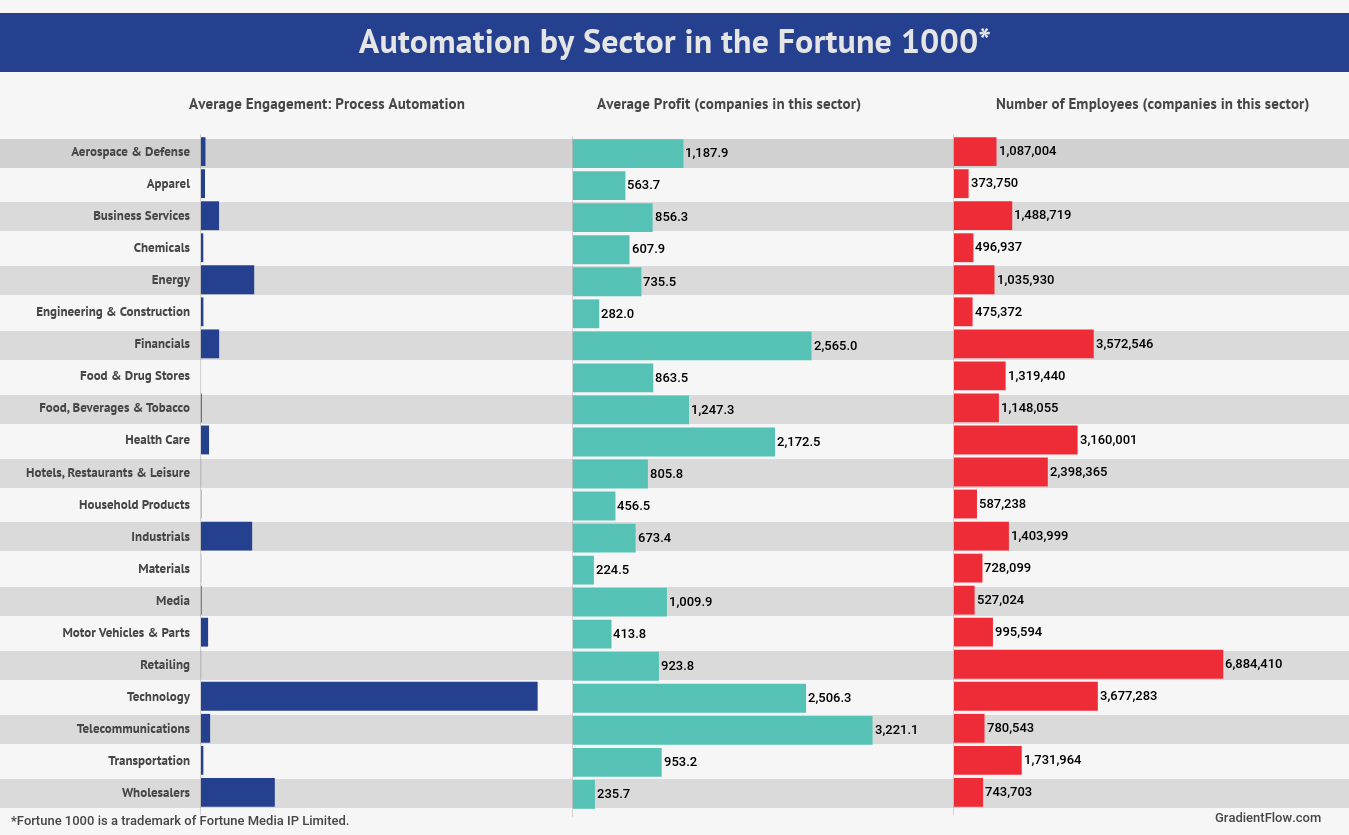
In this post, we take a look at process automation engagement trends in Fortune 1000 companies. We will examine three main categories of process automation: Business Process Automation (BPA), Robotics Process Automation (RPA) and Intelligent Process Automation (IPA), and review how the most-engaged companies are implementing automation technologies.

Business Process Automation
Businesses implement Business Process Automation to perform low-level repeatable tasks, such as processing expense reports, involved in multi-step business processes that produce a service or product. For example, a finance company might automate steps of a loan application process.

Any or all of a processes tasks could be automated to improve efficiency, reallocate resources, and to free team members from performing mundane, repetitive tasks.
Robotic Process Automation
Robotic Process Automation emerged from BPA. RPA added rudimentary intelligence to automation. In RPA, a piece of software called a “bot” is trained to perform a repetitive task, such as screen scraping, copying and pasting data into fields to fill out forms, and other office and customer service tasks.

In practice, RPA tools include software that automates user input like mouse clicks, web scraping, web crawling, and other graphical user interface (GUI) elements. Many modern applications provide APIs that obviate the need for RPA solutions. RPA remains a widely used technology, however, because many legacy systems are not able to provide APIs, and RPA software provides accessible solutions in those cases.
Increasing business interest in reducing costs and increasing revenues through automation is driving the Robotic Process Automation market. A recent Market Analysis Report from Grandview Research estimates the value of the RPA market in 2020 at USD $1.57B, and forecasts the compound annual growth rate (CAGR) at 32.8% from 2021 to 2028. The report notes that the addition of AI technologies into RPA will “aid in structuring unstructured data, enhance business insights, and improve data integrity,” which will “augment the market growth over the forecast period.”
As tools and solutions become more accessible and more affordable, and as the RPA market matures, businesses will be able to automate increasingly complex business processes using RPA technology. The next step, and the bigger vision, though, is Intelligent Process Automation.
Intelligent Process Automation is the newest set of process automation technologies. It combines fundamental process redesign with robotic process automation and machine learning. A recent survey by IBM Research AI, “From Robotic Process Automation to Intelligent Process Automation,” studied how recent advances in IPA, such as machine learning and AI, are beginning to disrupt the automation of business processes. The survey report describes the vision of IPA as “[building] on traditional RPA technologies, while going a step further to automate complex tasks which require decision-making, insights, and analysis.”
IPA mimics job functions performed by humans and, over time, learns to do them even better. Traditional levers of rule-based automation are augmented with decision-making capabilities thanks to advances in machine learning, information retrieval, and related technologies. The promise of IPA is radically enhanced efficiency, increased worker performance, reduction of operational risks, and improved response times and customer journey experiences.
Ultimately, fully automating complex business processes will require multiple IPAs, and the collaboration and coordination between the IPAs.
Realizing the IPA vision remains elusive for most companies, for several reasons. First, the cost to build and maintain IPAs is higher than RPAs. AI models not only must be trained, but because an IPA is performing end-to-end job functions and processes, the entire AI lifecycle must be monitored and maintained; AI models need to be retrained as business processes evolve and new data is introduced.
Adoption rates of IPA remain low outside the largest, most AI-sophisticated companies for reasons similar to other machine learning and deep learning applications. There are also inherent risks in automating processes dependent on data, such as overlooking various biases in the data, producing flawed outcomes. There are challenges around gaining buy-in and trust from non-technical stakeholders, which will require organizational adjustments, and in some cases restructuring, to overcome. Ultimately, fully automating complex business processes will require multiple IPAs, and the collaboration and coordination between the IPAs. This level of complexity will require new frameworks to enable IPA cooperation, and there will need to be an interface to facilitate communication between the IPA and the end user. Large investments in technologies that have extended periods of development, production, and implementation before ROI is realized are beyond the scope of possibilities for many companies.
Levels of IPA
Depending on the task or process that needs to be automated, Intelligent Process Automation often is more of a journey than a destination. An IPA solution isn’t a single piece of software or technology that you implement—it’s the result of a series of technology advancements that build upon one another in order to arrive one day at full automation. Inspired by maps illustrating progress levels for autonomous driving and conversational assistants, we propose similar levels for the evolution of IPA solutions. Figure 6 illustrates these levels. In a follow-up post, we’ll take a deeper dive into the products and solutions companies are offering at each stage of each level.

The level of IPA a company can achieve depends on their progress in implementing AI applications and solutions, and on advances in enabling technologies such as machine learning, HCI, and computing. Depending on the application, an IPA level might require progress in multi-modal models—models which rely on many modalities: structured data, text, voice, and images, for example. Even if a company masters one modality, they might not have capabilities in other modality areas necessary to achieve full IPA for a specific workflow.
It’s important to have realistic expectations as to when fully autonomous solutions can be delivered. Self-driving cars and automated personal assistants are good examples: both continue to make steady progress, but aren’t yet to the level of full automation.
This isn’t to say that the pursuit of IPA is fruitless or a wasted endeavor. Each step on the path to full automation is a necessary means to the end. It’s also important to keep in mind there are many systems today that deliver partial automation, yet are able to increase productivity and reduce operational costs for many companies. One example is AutoML—data science and data engineering skills are still necessary, but AutoML allows teams to do more. These partial solutions are part of the journey toward full automation.
The following infographic highlights areas of automation engagement from Fortune 1000 companies to shed light on the current state of BPA, RPA, and IPA across industries and use cases. Fortune 1000 companies are making steady progress through the early stages of IPA development and deployment. We found that the majority of process automation examples we came across in Fortune 1000 companies fall under BPA and RPA, and we expect this will continue for the near future for most companies as they navigate integration and implementation challenges inherent in process automation technologies.

Related content:
- FREE Report: 2021 Trends in Data and AI
- Applications of Reinforcement Learning: Recent examples from large US companies
- Speech synthesis technologies will drive the next wave of innovative voice applications
- What is DataOps?
- Model Monitoring Enables Robust Machine Learning Applications
Subscribe to our Newsletter:
We also publish a popular newsletter where we share highlights from recent podcast episodes, trends in AI / machine learning / data, and a collection of recommendations.
Fuente: Gradient Flow